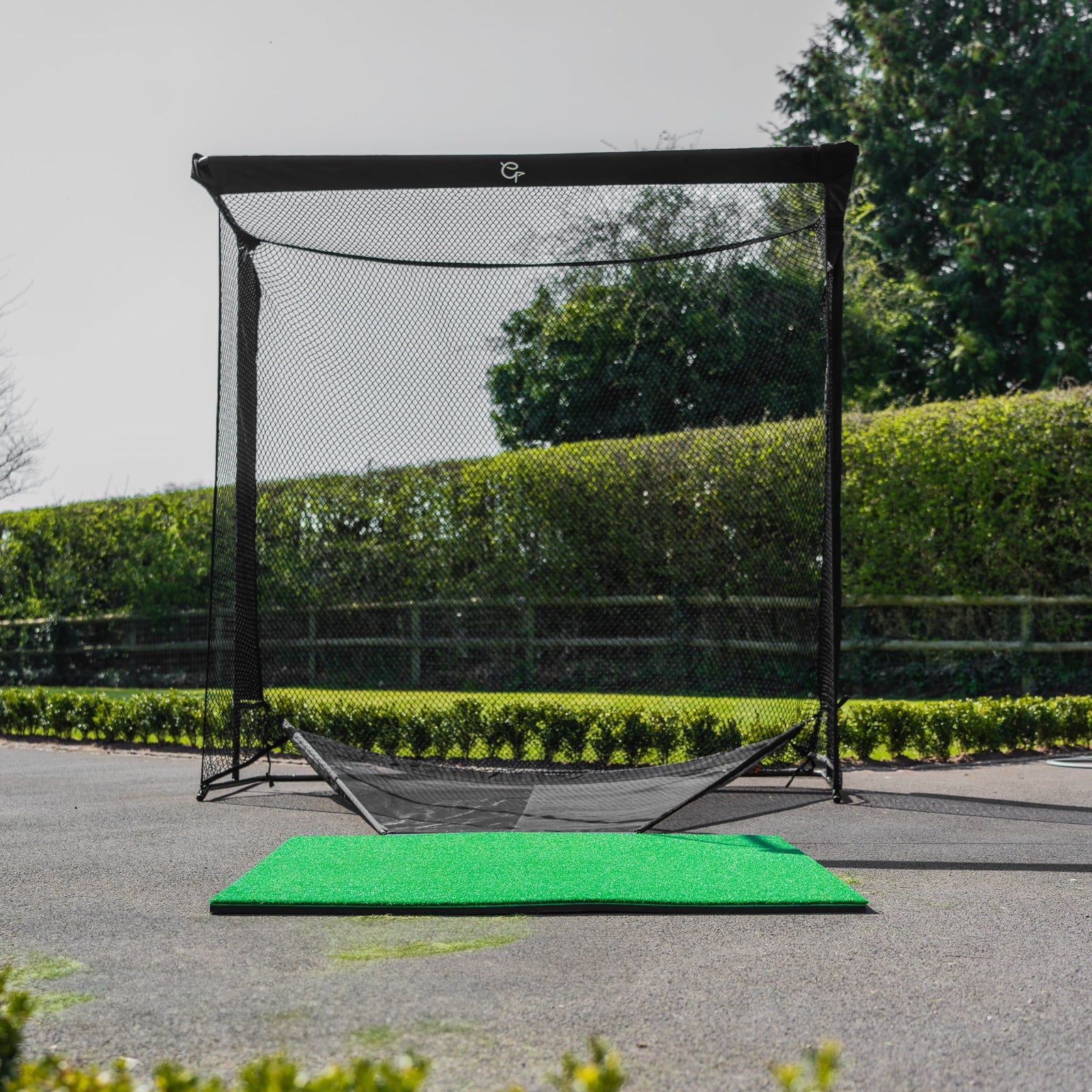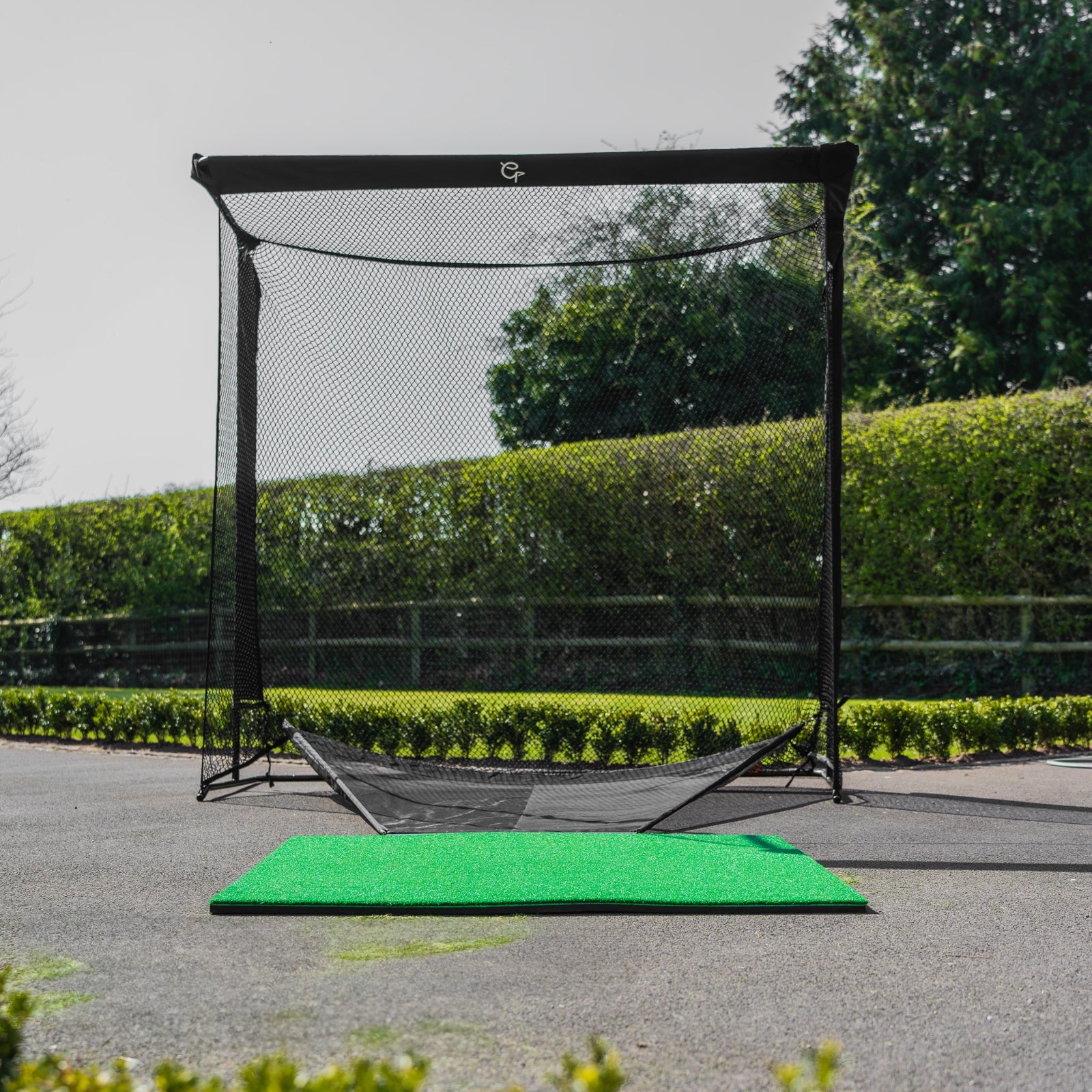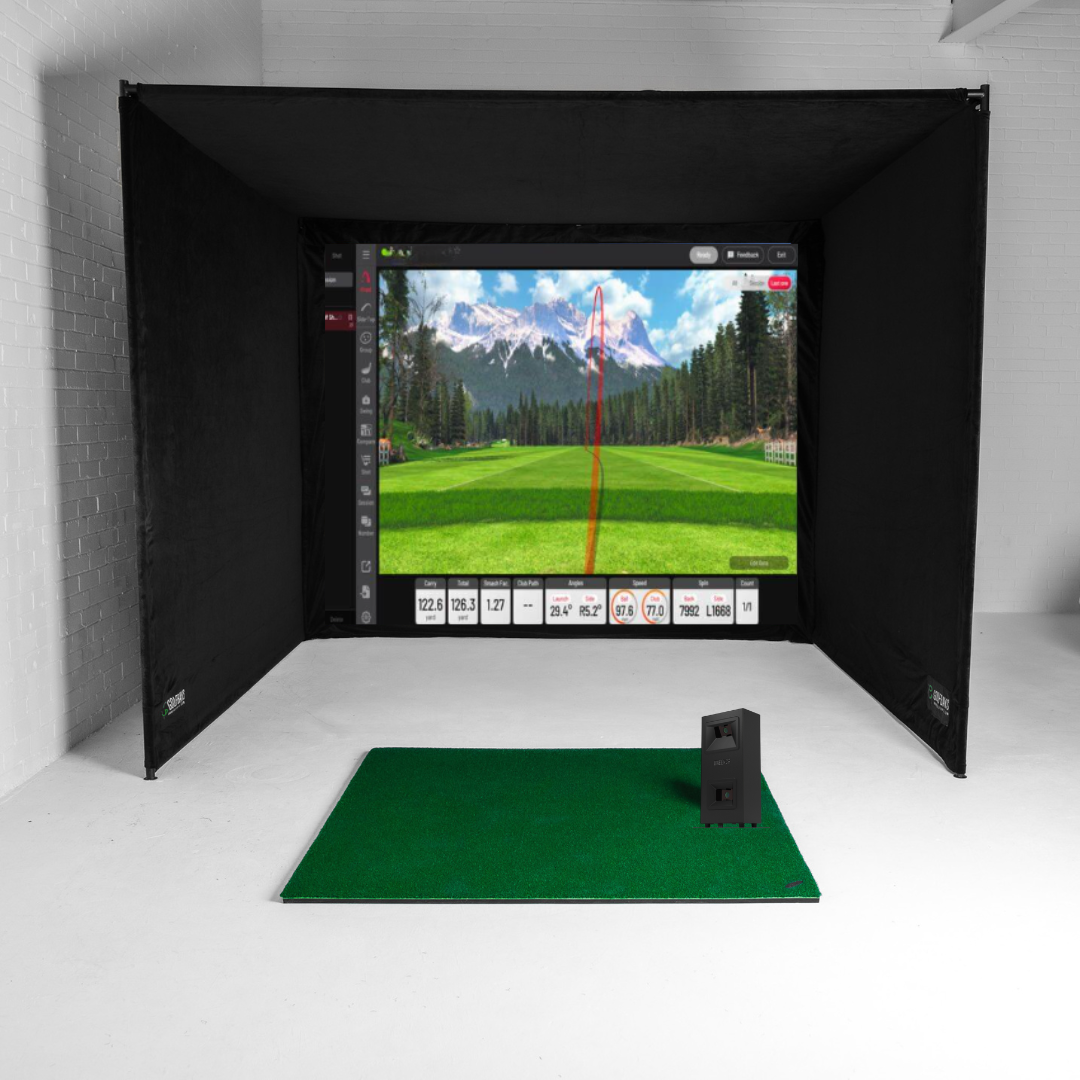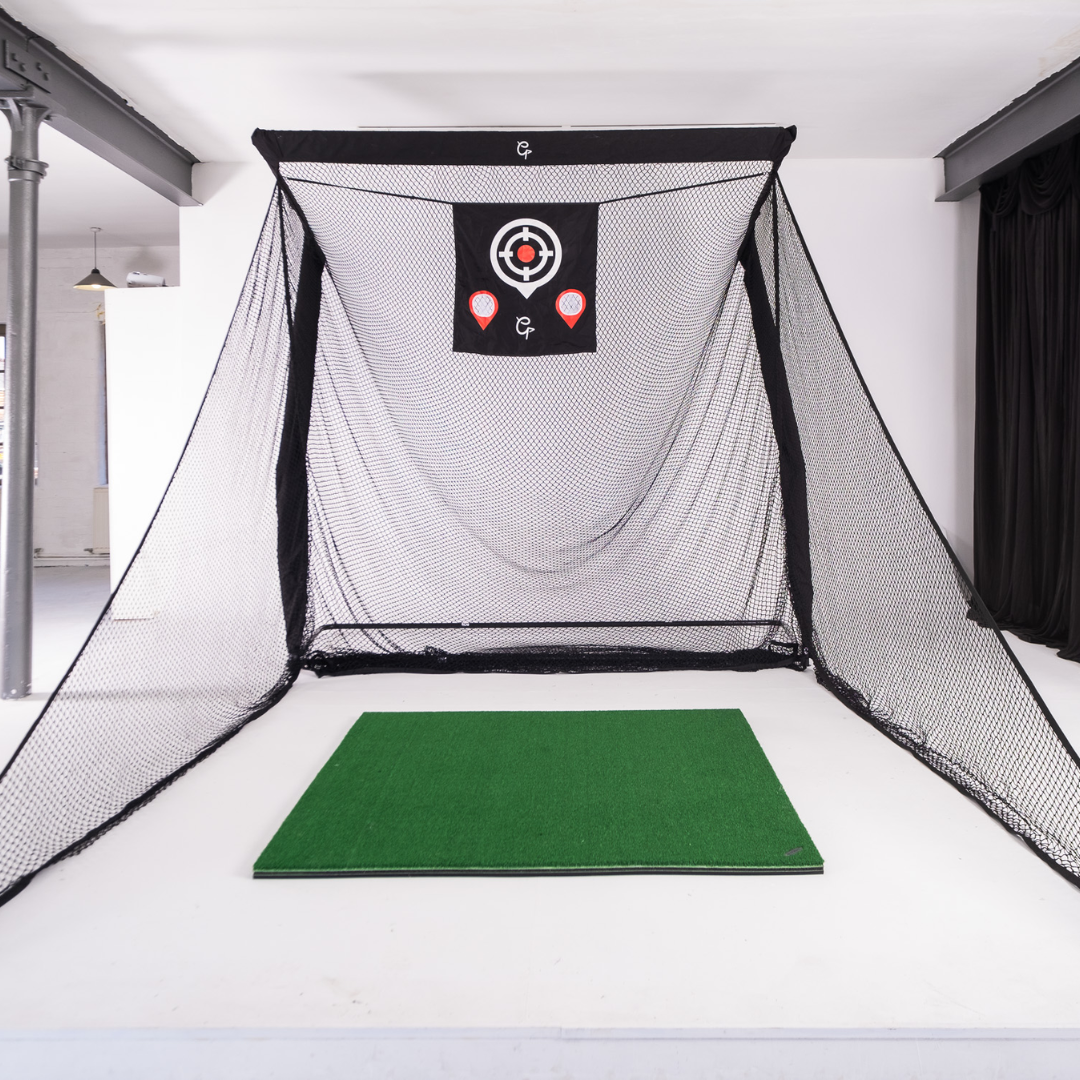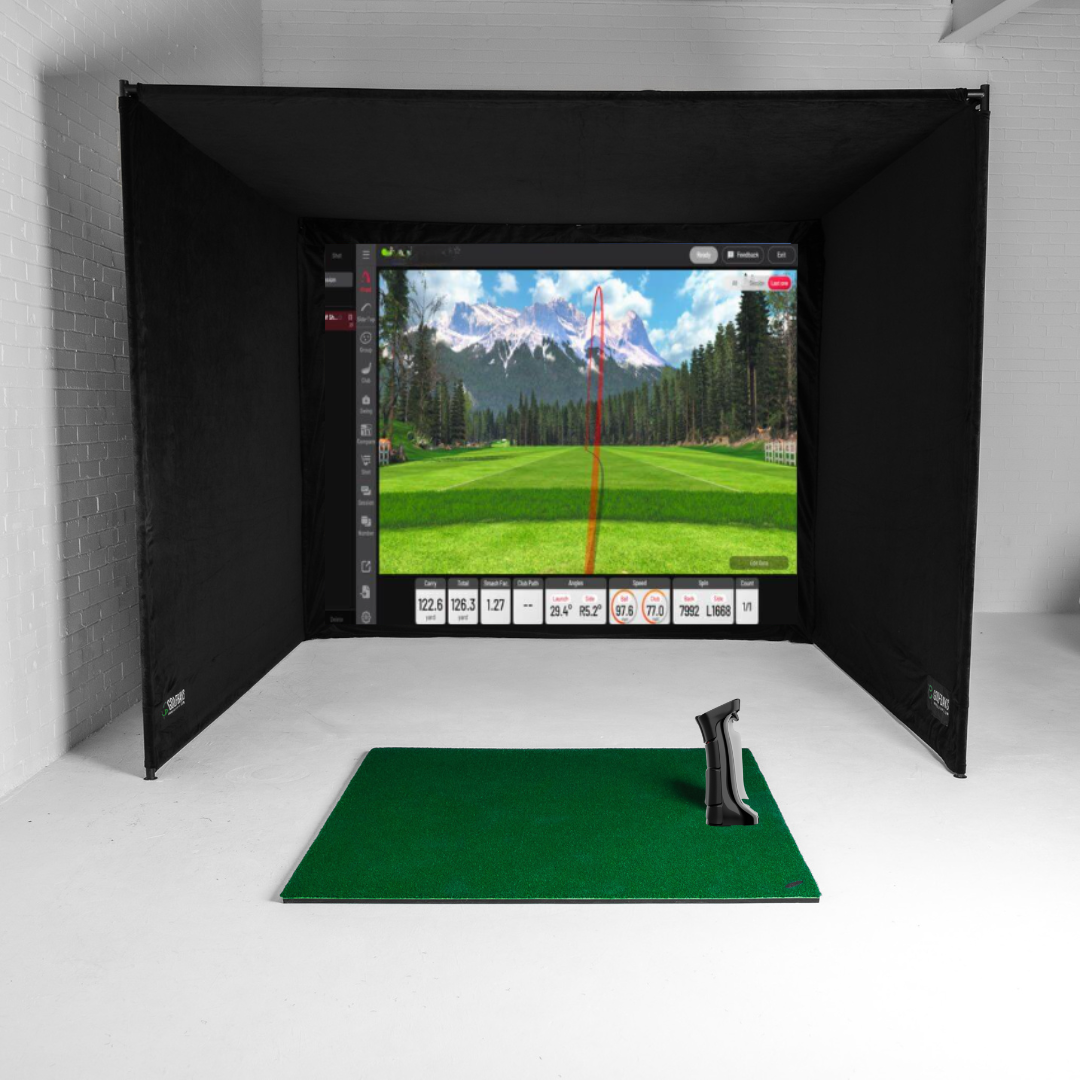






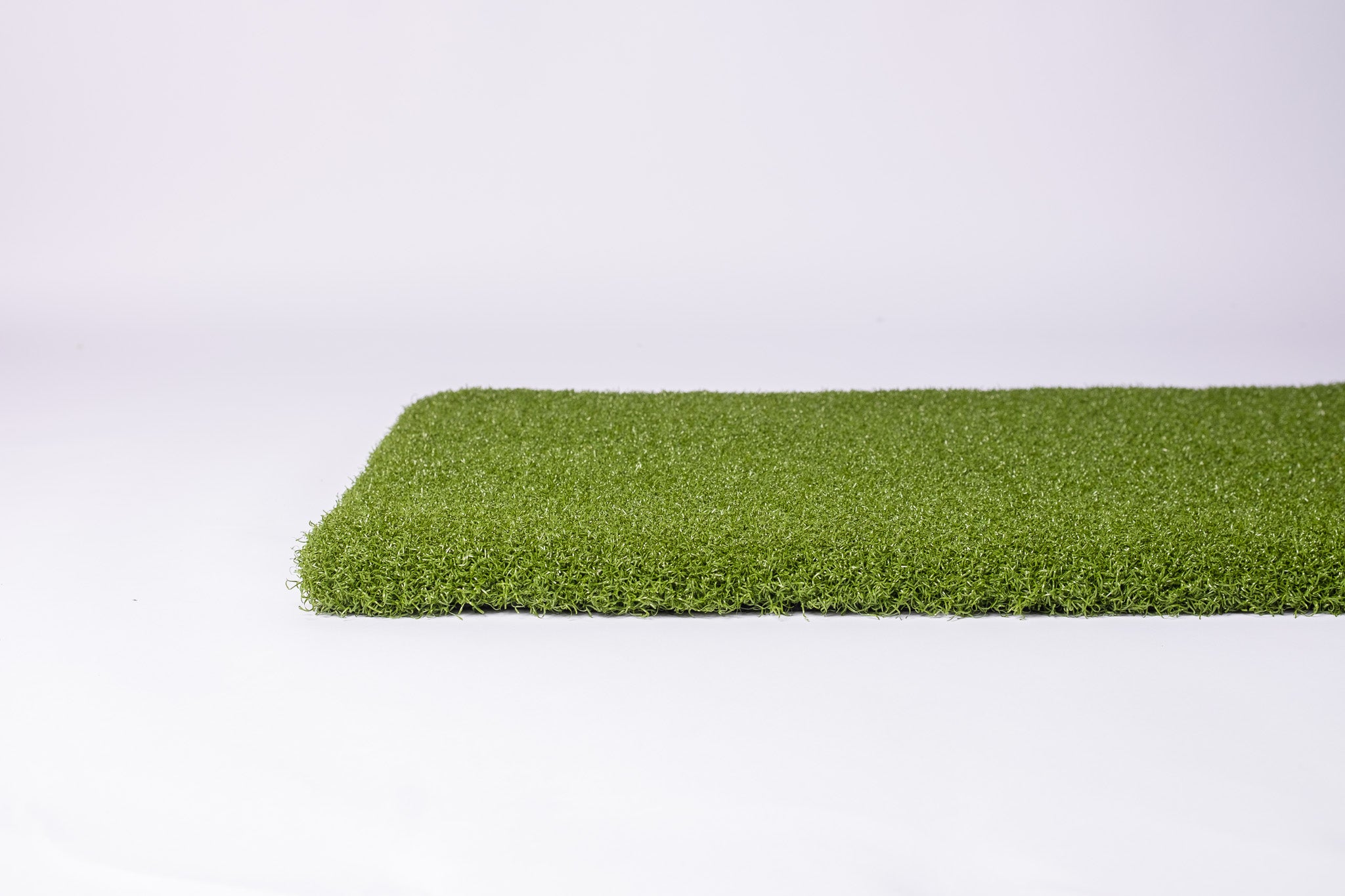







Every shot in a golf simulator is played off the hitting mat, so it takes more punishment than anything else in the room, your elbows included. A good one cushions the heavy strikes, holds the tee you want and sits flat for the launch monitor. These are the 10 mats we'd put in a UK garage or spare room, grouped by what you need the mat to do.
Quick summary
- Our pick for most home simulators is the GolfBays Quad Tech at £229: 1.5m square and 30mm deep, with 4 layers built to go easy on your wrists.
- On a tight budget, the GolfBays Standard at £199 gives you the full 1.5m x 1.5m with shock absorbers on a heavy rubber base.
- Buy a mat big enough for both feet and the ball, which in a simulator means 1.5m x 1.5m or more.
- To tee up with a real wooden tee at any height, choose a nylon insert tee mat, from £329 for 1.5m x 1.5m.
- Keep a camera launch monitor level with the top of the mat: on a 30mm mat, that means standing it on the mat or raising it 30mm.
- On a concrete garage floor, 20mm EVA foam underlay at £85 for 5 square metres cushions the floor and cuts the noise.
Best golf simulator mats at a glance
Prices are GolfBays prices on 30 September 2026. Within each group the mats run cheapest first, and our overall pick is number 5.
| Hitting mat | Size | Teeing up | Best for | Price |
|---|---|---|---|---|
| 1. GolfBays Standard | 1.5m x 1.5m | Tee peg holes | A first simulator on a budget | £199 |
| 2. GolfBays Teaching | 1.5m x 1.5m | 4 tee holes | Spreading the wear | £239 |
| 3. GolfBays Tri Turf | 120 x 180cm | Insert tee strip | Practising different lies | £329 |
| 4. GolfBays Combi Mat Duo | 185 x 129cm | Real tee in the nylon insert | Irons and driver off one mat | £429 |
| 5. GolfBays Quad Tech | 1.5m x 1.5m | Rubber tee holes | Most home simulators | £229 |
| 6. TrueStrike Mk7 Portable | 1 gel section | TrueStrike tees | Gel feel on a budget | £354 |
| 7. TrueStrike Mk7 Static | Gel plus 2 range sections | Tee holder and TrueStrike tees | Iron practice | £582 |
| 8. GolfBays Nylon Winter Insert Tee Mat | 1.5m x 1.5m | Real tee anywhere | Teeing up like the course | £329 |
| 9. GolfBays Winter Insert Tee Mat | 3m x 1.5m | Real or rubber tees | A wall-to-wall hitting area | £599 |
| 10. TrueStrike Mk7 Academy | Gel plus 4 range sections | Tee holder and TrueStrike tees | A centre hitting position | £798 |
How we chose these hitting mats
4 things, in the order they rule mats out: the size, what sits under the turf, how the mat holds a tee, and what the mat has to sit on. Price comes last, because a cheap mat that jars your elbows gets replaced, and a small one leaves a foot on the floor.
If you're buying the bay in one go, some of the complete home golf simulators we sell come with the Standard mat below in the box, so check the package before you buy a second one.
Best budget golf simulator mats
In a cheap golf simulator, the mat is the part not to skimp on. You stand on it for every shot, and a thin one on a concrete floor sends every heavy strike straight up your arms.
1. GolfBays Standard Hitting Mat: best under £200

The Standard is the mat we'd start a first simulator on. It's the full 1.5m x 1.5m, so your feet and the ball share the same surface with every club, and at 29mm deep it has shock absorbers built in over a heavy rubber bottom that keeps it where you put it.
It has holes for tee pegs, and it's made for sim rooms, gardens and commercial centres alike.
The GolfBays Standard Hitting Mat is £199.
The catch: you tee up from its tee peg holes, not wherever you like. If you want a wooden tee at exactly the height you use on the course, look at the nylon insert tee mats further down.

The GolfBays Basic hitting mat is the same 1.5m square with a rubber bottom and tee peg holes, 27mm deep, for £189. For £10 more, the Standard adds shock absorbers and 2mm of depth.
Best all-round golf simulator mats
These 3 do more than one job: a mat that shares its wear around, one with 3 lies to hit from, and one that swaps between an iron strip and a driver strip.
2. GolfBays Teaching Hitting Mat: best for spreading the wear

The Teaching mat is a range mat made for coaches, and the same things make it a good all-rounder in a bay that gets used most evenings. It's high-grade nylon sport turf on a foam base that softens the club's impact, 29mm deep in all, and it's built for winter and summer use.
The clever bit is the tee holes. There are 4, one on each edge, so you can turn the mat 90° and still have a tee hole in the same spot, with fresh turf around it. The teaching markings, a yellow cross inside a white frame, give you something fixed to line up against.
The GolfBays Teaching Hitting Mat is £239, with a 5-star average from 19 reviews on our site.
The catch: the markings are there for good. If you want a plain green mat that looks like a fairway, this isn't it.
3. GolfBays Tri Turf Hitting Mat: best for practising different lies

Most mats give you the perfect lie every time, which the course never does. The Tri Turf gives you 3 strips to hit from, in insert tee turf, fairway turf and rough turf, set into a 120cm x 180cm mat with room to stand.
It's built for indoor or outdoor use and for home or commercial bays, so it'll do a garden net in summer as happily as a garage simulator in winter.
The GolfBays Tri Turf Hitting Mat is £329.
The catch: it's a different shape from the 1.5m square most simulator bays are planned around, so mark where the ball will sit before you order.
4. GolfBays Combi Mat Duo: best for switching between irons and driver

The Duo is a 120cm x 120cm stance mat with a 30cm x 120cm hitting strip set into it, and the strip comes out. You get 2: a turf insert for irons, made from the same material as the stance mat, and a nylon insert that takes a real wooden tee for your driver.
It measures 185cm x 129cm overall, it's built for indoor and outdoor use, and it suits left and right-handed golfers.
The GolfBays Combi Mat Duo is £429.
The catch: changing club type means changing the strip, which is fine for a practice session and a faff in the middle of a round.

For a mat with the ball tray built in, the GolfBays Combi Mat Single Handed comes as a kit for £389: a 129cm x 159cm rubber base, a 120cm x 120cm hitting mat, a 120cm x 30cm winter tee strip and a rubber ball tray.
Best joint-friendly golf simulator mats
If you hit balls most evenings, what's under the turf matters more than the turf. These 3 are built to give a little when you catch one heavy.
5. GolfBays Quad Tech Hitting Mat: our pick for most home simulators

The Quad Tech is built in 4 layers, a soft artificial grass top, shock-absorbing bristles and a foam layer over a heavy rubber base, to protect your wrists, arms and lower body through a long session.
It's the full 1.5m x 1.5m and 30mm deep, with rubber tee holes, and all 13 of its reviews on our site give it 5 stars.
The GolfBays Quad Tech Hitting Mat is £229, £30 more than the Standard.
The catch: it looks like a range mat, so in a room that doubles as the lounge, the black version below blends in better.

The GolfBays Premium Black Hitting Mat is the Quad Tech's 4-layer build in black, 30mm deep, for a room that shouldn't look like a driving range. It's £329.
6. TrueStrike Mk7 Portable: best gel mat on a budget

TrueStrike mats work differently. Under a top surface that reacts like grass when you hit it sits a gel-filled layer, so the club head plays through the surface the way it would through a fairway.
The Portable is the smallest and cheapest complete mat in the TrueStrike range: 1 gel section framed by 2 edge trims, with 25 long and 25 short TrueStrike tees in the box.
The TrueStrike Mk7 Portable is £354.
The catch: it's a hitting surface, not a stance. You stand beside it, so on a bare floor your feet sit lower than the ball unless the floor around it is built up to match.
7. TrueStrike Mk7 Static: best for iron practice

The Static adds 2 range sections to the gel section, which gives you somewhere to stand, and it's made for practising with irons. A tee holder, 2 edge trims and 50 TrueStrike tees come in the box.
If you spend your sessions grooving a 7-iron and working through the wedges, this is the TrueStrike we'd pick for the money.
The TrueStrike Mk7 Static is £582.
The catch: it's an irons mat. For driver practice as well, TrueStrike recommends its Single mat, which takes irons and drivers (TrueStrike).

The TrueStrike Mk7 Single has the same gel section with 3 range sections, a ball tray and a tee holder, for £714.
Best premium and commercial golf simulator mats
Nylon turf is denser and harder-wearing than the turf on a standard mat, which is why our nylon mats double as winter tee areas for driving ranges. It's also the turf that holds a real tee. The group ends with TrueStrike's Academy, a centre-strike layout made for coaches, pros and driving ranges.
8. GolfBays Nylon Winter Insert Tee Mat: best for real tees

Push a wooden tee into this mat anywhere you like, at whatever height you use on the course. The premium nylon turf is dense enough to hold it, and it's built to take the wear of a range.
It's 1.5m x 1.5m and 35mm deep, on a heavy-duty foam base that keeps it stable, and it goes straight onto the floor or into one of our anti-shock frame bases, indoors or out.
The GolfBays Nylon Winter Insert Tee Mat is £329.
The catch: at 35mm, it and its black version are the thickest 1.5m mats here, so a camera launch monitor beside either has further to be raised.

The Nylon Winter Insert Tee Hitting Mat in black is the same 1.5m, 35mm mat for £399.99.
9. GolfBays Winter Insert Tee Mat 3m x 1.5m: best full-bay mat

This is the nylon tee mat at twice the size: 3m x 1.5m, with 30mm of nylon turf on 5mm of foam. Laid across a 3m-wide bay it runs wall to wall, so there's no edge to catch a heel on and no floor showing beside it.
It takes wooden or plastic tees, with holes for rubber tees as well. In a 4m-wide bay shared by a left-hander and a right-hander, put the ball in the middle and there's 1.5m of mat either side, so both play from the same spot without moving the mat.
The GolfBays Winter Insert Tee Mat 3m x 1.5m is £599.
The catch: at 3m long it's a mat you lay once and leave, not one you roll away after every session.
10. TrueStrike Mk7 Academy: best for a centre hitting position

Some launch monitor setups want the ball in the middle of the bay. The Academy puts TrueStrike's gel section in the centre of the mat, with range sections either side of it to stand on.
It comes with 4 range sections, 2 edge trims, a tee holder and 50 TrueStrike tees, and it's made for the coaching and simulator bays that need that centre position.
The TrueStrike Mk7 Academy is £798, the dearest of our 10 picks.
The catch: the money buys the layout. If your launch monitor is happy with the ball off-centre, the Static gives you the same gel for £216 less.

For a bay shared by a left-hander and a right-hander, the TrueStrike Mk7 Double has 2 gel sections, 4 range sections and 2 ball trays, for £1,242.
Not sure which mat suits your bay?
Tell us the floor, the launch monitor and who'll be swinging, and we'll point you to the right mat and what goes under it. It's free.
Book a free consultationWhat size golf mat do you need for a simulator?
1.5m x 1.5m for most bays. That's big enough to get both feet and the ball on the mat with every club, from a wedge to a wide driver stance.
| Size | Our mats | What it suits |
|---|---|---|
| 1.5m x 1.5m | Basic, Standard, Teaching, Quad Tech, Premium Black, Nylon Winter Insert Tee | Most home simulators, with the stance and the ball on one mat |
| 120 x 180cm | Tri Turf | Practising from 3 different lies |
| 185 x 129cm | Combi Mat Duo | Iron and driver strips in one mat |
| 3m x 1.5m | Winter Insert Tee Mat | Wall to wall in a 3m-wide bay, or a 4m bay shared by left and right-handers |
Measure your driver stance, outside heel to outside heel, before you choose. The mat wants room either side of that so neither foot ends up on the edge.
For the room around the mat, plan on 3m of width, about 2.8m of height for a full driver swing, and 4.5m of depth with a camera unit beside the ball, or 5m with a radar unit behind you.
✓ Do this
Stand with both feet on the mat, so your feet and the ball are at the same height for every club.
✕ Not this
Hit off a narrow strip with your feet on the floor beside it. Every shot is then played with the ball slightly above your feet: a sloping lie on a flat floor.
What is a golf hitting mat made of?
3 parts do the work. The turf is what you hit from, a shock layer under it gives when the club comes down, and a base keeps the mat flat and stops it sliding. How thick and how soft those are decides how the mat feels, and across our 1.5m mats the total runs from 27mm to 35mm.
| Mat | Under the ball | Total depth |
|---|---|---|
| GolfBays Basic | Turf on a rubber bottom | 27mm |
| GolfBays Standard | Turf with shock absorbers on a heavy rubber bottom | 29mm |
| GolfBays Teaching | Nylon sport turf on a foam base | 29mm |
| GolfBays Quad Tech and Premium Black | 4 layers: soft turf, shock-absorbing bristles and foam on a heavy rubber base | 30mm |
| GolfBays Nylon Winter Insert Tee | Dense nylon turf on a heavy-duty foam base | 35mm |
The turf. Short, dense range turf is hard-wearing and firm. Softer turf lets the club slide through with more give, and nylon is denser and harder-wearing again, dense enough to hold a real tee.
The shock layer. This is the part your joints notice. Foam, rubber and, on the Quad Tech, shock-absorbing bristles take the sting out of a heavy strike. On a TrueStrike, a gel-filled layer takes the strike instead.
The base. A heavy rubber bottom grips the floor and keeps the mat flat; foam is lighter and softer underfoot. A thin range mat laid straight on concrete is a quick way to find out you have elbows.
Can you use a real tee on a golf simulator mat?
Yes, on the right mat. There are 3 ways a mat holds a tee, and they decide whether you can tee the ball up the way you do on the course.
| Tee system | How it works | On our mats |
|---|---|---|
| Tee holes | A rubber tee sits in a hole in the mat, so the tee height is the height of the rubber tee | Basic, Standard, Teaching, Quad Tech |
| Nylon insert tee turf | Push a wooden or plastic tee straight into the turf, wherever you like | Nylon Winter Insert Tee mats, the Combi Mat Duo's nylon insert, the Tri Turf's tee strip |
| TrueStrike tee holder | A tee holder that comes with the mat takes TrueStrike's own tees, in long and short heights | TrueStrike Static, Single, Academy and Double |
Rubber tees are simple and they last. What they can't do is move, and the ball position is set by the hole, not by where your launch monitor wants the ball.
Nylon insert tee turf is the answer if tee height matters to you, or if the ball has to sit in one exact spot for the launch monitor, because the tee goes wherever you push it.
The hitting area wears first, since every shot is struck from the same few centimetres. On mats built around a strip, you replace the strip and keep the mat.

Our Winter Insert Tee Hitting Mat Strip is a 1m x 0.5m deep-pile nylon strip for £99, made as a winter tee area for golf courses and just as much at home in a simulator.

For a ceiling-mounted launch monitor bay, the Nylon Winter Insert Tee Strip is a 0.6m square of nylon that takes a real tee anywhere, made to fit Trackman, ProTee and Uneekor hitting areas, for £150.
GolfBays tip
If your mat has a tee hole on each edge, like the Teaching mat, turn it a quarter once the turf around the ball starts to flatten. There's still a tee hole where the launch monitor expects the ball, and the wear moves on to fresh turf.
Why does a camera launch monitor need a flat, level mat?
Because it reads the ball from beside it. Camera launch monitors sit across the ball from you and photograph it at impact, so the height of the unit against the ball matters.
SkyTrak asks for its unit to sit on the hitting surface or at the same height as it, and as level as possible (SkyTrak). Garmin gives the same instruction for its camera unit: place it at the same level as the hitting mat (Garmin).

On a 30mm mat laid on the floor, that means standing the unit on the mat itself or raising it 30mm.
The tidier fix is to set the mat into the floor. 20mm of our EVA underlay plus 11mm putting turf comes to 31mm, within 1mm of the Quad Tech's 30mm, so cut both layers away where the mat goes. The mat, the turf and the launch monitor then sit level, and the turf holds the mat in place.
Flat matters as much as level. A mat that has curled at the edges or worn a dip where the ball sits changes the height at the one spot that counts. Garmin also asks you to keep reflective surfaces out of the camera's view, so a shiny painted garage floor is worth covering.
Watch out: the step down
Stand a camera unit on the floor beside a 35mm nylon mat and it sits 35mm below the hitting surface. SkyTrak and Garmin both want the unit level with the hitting surface, so check the height before you blame the numbers.
What goes under a hitting mat on a concrete garage floor?
A garage golf simulator starts on a concrete slab, and concrete gives nothing back. The mat's own shock layer looks after your joints; what goes under it stops a smooth-backed mat creeping on a smooth floor and takes the edge off the noise.

A rubber base holds the mat still. Our rubber base for 1.5m mats is a frame of heavy, non-slip rubber that a 1.5m x 1.5m mat drops into, 1.56m square on the outside, for £109. It has drainage holes, so the same frame turns a mat into a tee area outdoors.

Foam underlay cushions the floor under the turf. Our golf simulator turf underlay is interlocking EVA foam tiles, 1m x 1m and 20mm thick, 5 to a pack for £85. It cushions the floor, cuts the noise of every strike, and reverses from black to grey.
The rubber base suits a mat that sits on its own; the underlay suits a bay where turf covers the floor and the mat is set into it, as in the drawing above.
Watch out: a mat that wanders
A mat that slides a little with every swing has moved by the end of the evening, and the ball is no longer where the launch monitor expects it. Frame it, recess it or put underlay beneath it before you set the launch monitor up.
Putting turf beside the hitting mat
Turf across the rest of the bay floor does 3 jobs: it gives you a surface to putt on, something softer than concrete to stand on between shots, and a room that looks finished rather than half-built.
Putting on a golf simulator works best when the ball rolls on turf, not off the edge of a 30mm mat, which is one more reason to set the mat flush.

Our putting turf is 11mm turf off a 4m-wide roll, cut to the length you choose at £24 a square metre, from £96 for 1m x 4m.

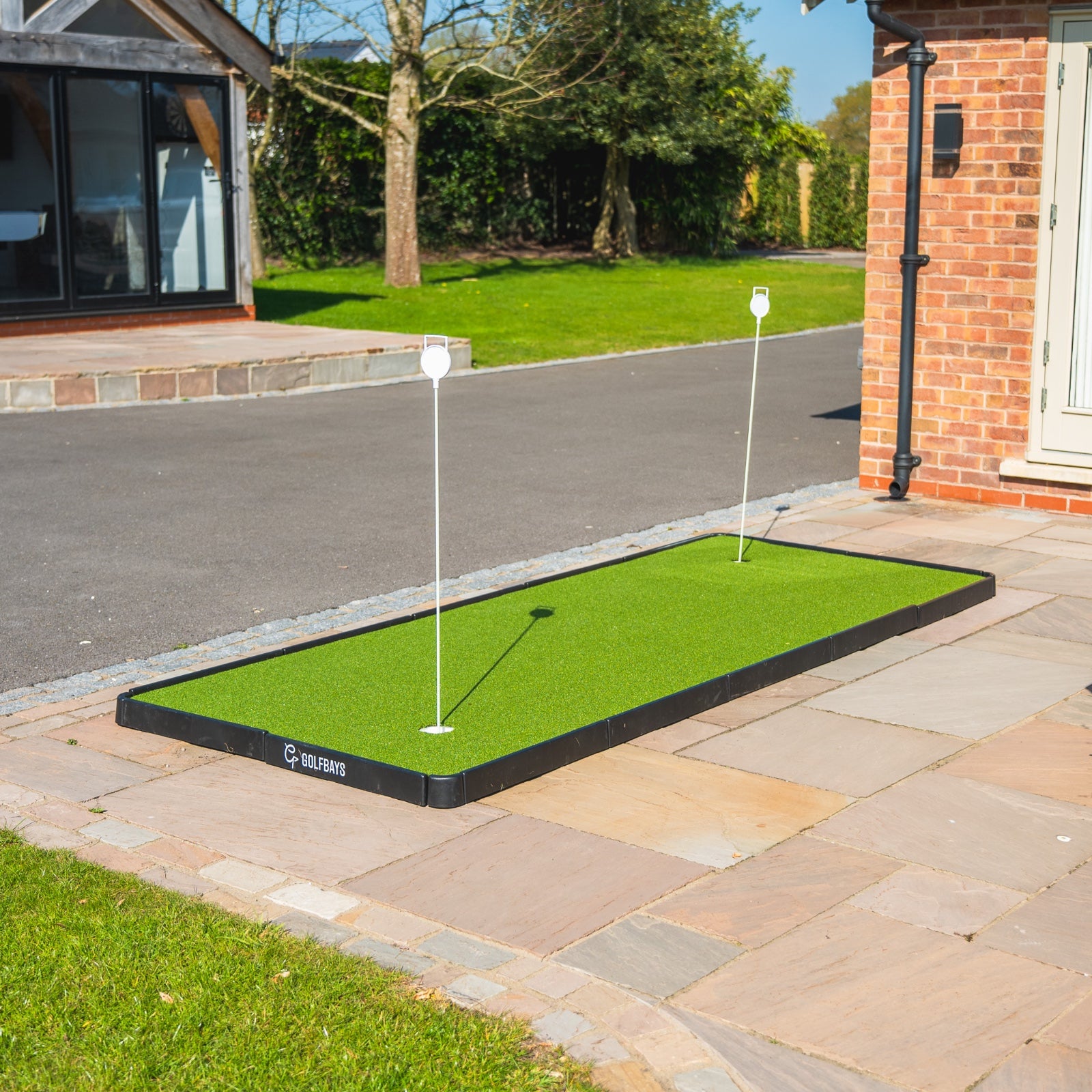
If you'd rather have a green you can pack away, the GolfBays Modular Putting Green comes apart into 2 boxes between sessions, with regulation cups in its pre-cut turf, for £399, down from £499.
Which golf simulator mat should you buy?
Pick by how the bay gets used:
- A first simulator on a budget: the GolfBays Standard at £199, or the Basic at £189.
- Most home simulators: the Quad Tech at £229, or the Premium Black if the room doubles as the lounge.
- A real tee at any height: the Nylon Winter Insert Tee Mat at £329.
- Irons and driver off swappable strips: the Combi Mat Duo.
- Different lies: the Tri Turf.
- A gel strike that plays through like turf: a TrueStrike, from the Portable at £354.
- Left and right-handers in one bay: the 3m x 1.5m Winter Insert Tee Mat, or the TrueStrike Mk7 Double.
Golf simulator mat FAQs
Which golf mat is best for a home simulator?
A 1.5m x 1.5m mat with a proper shock layer. Our pick is the GolfBays Quad Tech at £229, 30mm deep with 4 layers built to go easy on your joints. If you want to tee up with real tees, the Nylon Winter Insert Tee Mat at £329 is the one.
Are golf practice mats worth it?
Yes, if you'll hit balls at home regularly. A good mat protects your wrists, elbows and floor, and a camera launch monitor needs the ball on a flat, level surface to read it properly. A full-size 1.5m mat starts at £189.
What type of flooring is best for a golf simulator?
Artificial turf over a foam underlay, with the hitting mat set into it. Our 20mm EVA foam tiles cushion concrete and cut noise, and 11mm putting turf on top gives you a surface to putt on. Carpet works in a spare room as long as the mat sits flat and doesn't slide.
Is 12x12 big enough for a golf simulator?
Wide enough for one golfer, usually not deep enough. 12ft is about 3.7m, which clears the 3m of width we plan for (4m if left and right-handers share the mat), but a camera unit beside the ball wants about 4.5m of depth and a radar unit 5m. Check the height too: a full driver swing needs about 2.8m.
How do you make a homemade golf mat?
Glue artificial turf onto a dense rubber or foam base and you've got something to hit from. What's hard to copy at home is the shock layer that protects your wrists and elbows, and turf dense enough to hold a real tee. A ready-made 1.5m mat starts at £189.
How thick should a golf simulator mat be?
Around 27mm to 35mm all in, the range of our 1.5m mats. Thickness matters most when a camera launch monitor sits beside the ball, because the unit has to be level with the top of the mat.
Do hitting mats affect launch monitor accuracy?
They can, through height and flatness. Garmin lists setting its camera unit at the same level as the hitting mat among its tips for accurate readings, and a worn dip or a curled edge changes the height under the ball.
Find the mat for your bay
From £189 starter mats to TrueStrike gel mats, with the bases and strips that go with them.
Shop golf hitting mats